How to Cancel a Gym Membership Without the Hassle
Step-by-step guide to canceling a gym membership: check your contract, choose online/in-person/certified mail, keep records, and dispute unwanted charges.
Canceling a gym membership can feel unnecessarily complicated, with many gyms requiring in-person visits, certified mail, or obscure procedures. Here's how to simplify the process:
- Review Your Contract: Check for cancellation terms, notice periods, fees, and special conditions like relocation or medical exemptions.
- Pick a Method: Options include online cancellation, visiting the gym, or certified mail for added proof.
- Document Everything: Save copies of forms, emails, and receipts to avoid future billing issues.
- Monitor Payments: Watch your bank statements for two cycles to ensure charges stop.
- Know Your Rights: State laws often override unfair terms. For disputes, contact your state attorney general, BBB, or FTC.
If your gym resists, escalate by filing complaints or disputing charges with your bank. Following these steps can save time, money, and frustration.
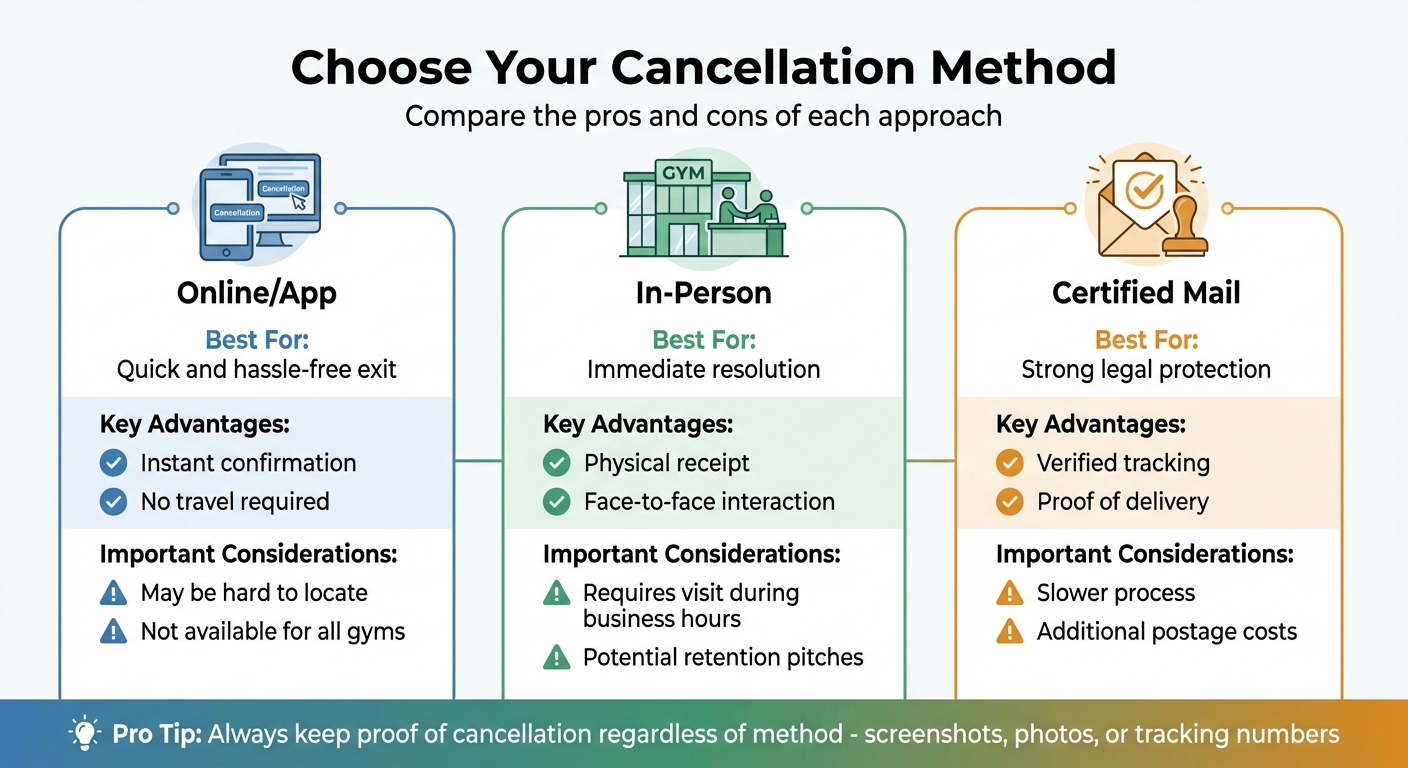
Gym Membership Cancellation Methods Comparison Chart
How to Cancel a Gym Membership
1. Review Your Contract and Know Your Rights
Start by locating your membership agreement and carefully reviewing its terms. While gym contracts are legally binding, state consumer protection laws can sometimes override unfair provisions. Attorney Thomas J. Simeone of Simeone & Miller LLP points out:
"Gym contracts are often difficult to terminate. That's not an accident. It's something gyms want to discourage, because every day, week, or month that you remain a member, you're paying more money."
Below, you'll find detailed steps on how to access your contract and understand the legal protections available to you.
1.1 Find and Read Your Contract
If you signed up online, your contract is likely in your email confirmation or accessible through your member portal. If you can’t find it, request a physical copy directly from the gym - most gyms are legally required to provide one.
When reviewing your contract, focus on specific details like notice periods for cancellation, early termination fees for fixed-term agreements, automatic renewal clauses, and any special cancellation rights. For example, many contracts allow termination due to relocation (usually 20–25 miles away), medical issues, or military service. Be sure to check for required documentation, such as a doctor’s note for medical cancellations or proof of a new lease for relocations.
Contracts often include a 30–45 day written notice requirement, early termination fees, and automatic renewals. Additionally, many states enforce a "cooling-off" period - ranging from 3 to 10 business days - during which you can cancel without penalties. For instance, Georgia mandates a 7-day cancellation window, and contracts without this provision are unenforceable. Similarly, California allows a 5-day window, while New York and Florida typically offer 3 business days. If you're within this cancellation period, act quickly.
1.2 Understand State and Federal Consumer Protections
State laws often provide stronger safeguards than what your gym contract outlines. For example:
- New York caps gym contracts at 36 months and $3,600 annually.
- Pennsylvania requires gyms that close for more than 30 days to either provide refunds or offer a comparable location within 10 miles.
- California allows members who paid large upfront fees to cancel for any reason within 20–45 days.
To understand the specific protections in your state, visit your state attorney general’s consumer protection website.
On a federal level, the FTC enforces consumer protection laws, which can serve as leverage if a gym resists your cancellation request. Knowing your rights is an essential step in navigating these situations effectively.
2. Select the Right Cancellation Method
Once you’ve reviewed your contract and understood your rights, it’s time to decide how you’ll cancel your gym membership. You typically have three options: online or app-based cancellation, in-person cancellation, or sending a certified mail request. Each approach has its own benefits, and the method you choose can impact how quickly your cancellation is processed and how well you’re protected in case of disputes.
While your contract might specify which methods are acceptable, here’s a breakdown of the most common options:
- Online/App: Convenient and fast, but not always easy to find or available.
- In-Person: Offers immediate resolution with the added benefit of a physical receipt.
- Certified Mail: Provides the strongest legal documentation, perfect if disputes arise.
Here’s a quick comparison to help you weigh your options:
| Method | Best For | Key Advantages | Important Considerations |
|---|---|---|---|
| Online/App | Quick and hassle-free exit | Instant confirmation; no travel required | May be hard to locate; not available for all gyms |
| In-Person | Immediate resolution | Physical receipt; face-to-face interaction | Requires a visit during business hours; potential retention pitches |
| Certified Mail | Strong legal protection | Verified tracking and proof of delivery | Slower process; additional postage costs |
No matter which route you take, always keep proof of your cancellation. Save screenshots, take photos of signed forms, and hold onto tracking numbers. These records can be lifesavers if billing issues crop up later.
2.1 Cancel Through Your Online Account or App
Many gyms now let you cancel digitally through their website or mobile app, though finding this option can sometimes feel like a scavenger hunt. After logging into your account, search areas like “Account Settings,” “Billing,” or “Membership.” Some gyms intentionally bury the cancellation option deep within their interface to discourage you from leaving.
Once you locate the cancellation option, follow the prompts carefully. Be prepared for offers to pause your membership, switch to a cheaper plan, or snag a special discount. You’re under no obligation to accept these offers - just decline and proceed. Don’t forget to take a screenshot of the final confirmation page or any reference number provided.
Additionally, look for an automated confirmation email. If you don’t receive one within 24 hours, contact the gym to ensure your request was processed. Save any emails as evidence, and check your bank statements for at least two billing cycles to confirm no unexpected charges pop up.
2.2 Cancel at the Gym Location
Canceling in person can be effective and straightforward, but it does require some planning. Start by calling your gym to confirm when a manager or authorized staff member will be available. Some gyms restrict cancellation authority to specific employees, which can complicate things if you show up unprepared. Bring your membership ID and be ready to clearly state your intent to cancel.
For example, you might say, “I’d like to cancel my membership effective [specific date].” While staff may offer discounts or other incentives to keep you, you don’t have to engage in a prolonged conversation. Politely but firmly decline and ask for the official cancellation form. Fill it out on the spot, and before leaving, request a signed and dated copy. For added security, snap a photo of the completed form. If the gym refuses to provide written confirmation, certified mail might be your best alternative to establish a clear record.
2.3 Cancel Using Certified Mail
Certified mail through USPS is your go-to option if you need rock-solid proof of your cancellation. This method is especially useful if your gym has a history of “losing” cancellation requests or doesn’t offer online options. Certified mail ensures that someone at the gym signs for your letter and provides tracking for added peace of mind.
When writing your cancellation letter, include key details like your full name, membership or account ID, the effective cancellation date (keeping any notice periods in mind), and a clear statement of your intent to cancel. For example: “I am writing to cancel my gym membership and stop all recurring charges.” You can also request written confirmation, specifying a deadline, such as: “Please confirm this cancellation in writing within 10 business days.”
At the post office, opt for Certified Mail with Return Receipt Requested (PS Form 3811). While this costs extra, you’ll receive a signed receipt showing who accepted your letter and when. Keep the receipt, tracking number, and a copy of your letter in a safe place.
If this process feels overwhelming, services like ByeGym can handle it for you. For a flat fee of $45, ByeGym will draft a professional cancellation letter, send it via Certified Mail with tracking and proof of delivery, and even provide a chargeback kit if your gym continues billing you after the cancellation notice.
3. Keep Records and Stop Unwanted Charges
Canceling your gym membership is just the first step. To ensure you're not hit with unexpected charges, it's crucial to keep thorough records and stay on top of your bank statements. Mistakes happen - gyms might lose your cancellation request or continue billing you. Protect yourself by documenting everything and monitoring your finances.
3.1 Save All Cancellation Documents
Think of your cancellation documents as a safety net. Keep copies of your original membership agreement (which outlines the cancellation terms), your written cancellation notice (whether it's a letter or a form), and any proof of delivery, like certified mail receipts or tracking numbers.
Avoid relying on verbal confirmations or phone calls alone. If someone confirms your cancellation over the phone, follow up with an email summarizing the conversation. Save all these records in a digital or physical folder that's easy to access.
3.2 Check Your Bank Statements and Dispute Charges
Once you've canceled, the next step is to keep a close eye on your financial statements. Check them for at least two billing cycles to ensure no unauthorized charges slip through. Keep in mind that many gym contracts include a 30-day notice period, which might result in one final payment after cancellation.
If you spot an unauthorized charge, act fast. Under the Fair Credit Billing Act (FCBA), your liability for unauthorized credit card charges is capped at $50, but you must send a written dispute letter within 60 days of the billing statement showing the error. Skip the phone calls - send a formal letter to your credit card company's billing inquiries address (not the payment address). Be sure to include your name, account number, and a detailed explanation of the error. Use certified mail to create a reliable paper trail.
"Federal law limits your responsibility for unauthorized charges to $50." - Federal Trade Commission
Your credit card issuer is required to acknowledge your dispute within 30 days and resolve it within two billing cycles or no later than 90 days. During this process, you have the right to withhold payment for the disputed amount. Credit cards typically offer better protections than debit cards, as issuers often suspend disputed charges immediately. Debit card users, on the other hand, might have to wait until the investigation is complete to see their money returned.
If your gym or bank refuses to cooperate, you can escalate the issue. File a complaint with your State Attorney General's consumer protection division, the Better Business Bureau (BBB), or the Consumer Financial Protection Bureau (CFPB). And if your gym sends your account to collections, remember that the Fair Debt Collection Practices Act gives you the right to dispute the debt and request verification.
4. Handle Special Situations and Disputes
Sometimes, life throws unexpected curveballs, and standard cancellation methods just don’t cut it. Whether you’re moving, dealing with a medical issue, or responding to military orders, there are legal protections that might allow you to cancel your gym membership - even if your contract seems ironclad.
4.1 Cancel Due to Relocation, Medical Issues, or Military Service
Relocating to a New Area
If you’re moving more than 25 miles from the nearest gym location, many state laws let you cancel your membership without penalties. To do this, you’ll typically need to provide proof of your new address, such as a lease agreement or a utility bill. These laws often override the terms of your gym contract.
Health Problems or Injuries
A serious medical condition or injury that prevents you from working out may also qualify you for cancellation. Most gyms require a doctor’s note, which should include your name, your doctor’s contact information, an explanation of why you can’t exercise, and the doctor’s signature with the date. Be sure to check your gym’s specific requirements before obtaining this documentation.
Military Deployment
If you’re an active-duty service member with deployment orders, you’re entitled to special protections. States like Maryland and Nebraska, for example, require gyms to allow cancellations without penalties or fees for military members. You’ll need to provide a copy of your deployment orders. In some cases, you may even be able to reinstate your membership under the original terms once your service ends.
For all these situations, send your supporting documents via certified mail and request written confirmation of the cancellation. Keep copies of everything for your records. If your gym doesn’t honor your valid cancellation request, you’ll need to escalate the issue, as explained below.
4.2 File Complaints and Take Legal Action
If your gym refuses to process your cancellation - even after you’ve submitted the proper documentation - you can take further steps. File a complaint with your State Attorney General’s consumer protection division, the Better Business Bureau (BBB), and the Federal Trade Commission (FTC) at ReportFraud.ftc.gov .
If the charges keep showing up on your account, you can take the matter to small claims court. For example, in California, you can sue for amounts up to $10,000. The process is designed to be straightforward, and you don’t need a lawyer. Filing fees are generally low, and under California law, you might even recover three times the amount of damages, plus reasonable attorney’s fees, if a gym violates the Health Studio Services Contract Law.
- A notable case occurred when the FTC filed a complaint against Fitness International, LLC (operators of LA Fitness), accusing them of obstructing cancellations. The complaint alleged that the gym required customers to use a hard-to-find printed form sent via certified mail, handled only by a specific employee. This practice reportedly cost 3.7 million members hundreds of millions of dollars in unwanted fees .
"While going to the gym is good for your health (and having a recurring source of revenue may be great for your business's bottom line), making people jump through hoops to cancel services is bad business (and unlawful)." - BCP Staff, Federal Trade Commission
If disputed charges are escalated to collections, you can use the Fair Debt Collection Practices Act (FDCPA) to dispute the debt in writing .
Conclusion
Canceling a gym membership doesn’t have to be a headache if you’re well-prepared. As mentioned earlier, knowing what your contract says and being aware of your rights is key. In many cases, state consumer protection laws can override overly restrictive terms in gym agreements. These steps help you protect yourself and ensure the process is resolved smoothly.
Make sure to follow the cancellation process outlined in your contract. If the gym provides an online cancellation option, use it. Otherwise, sending a cancellation letter through certified mail with a return receipt is a smart move to establish a clear paper trail. Always ask for written confirmation that your membership has been terminated and that no outstanding balance remains.
Keep all relevant documentation related to your cancellation. This can be invaluable if you’re still being billed after you’ve canceled.
If your gym refuses to honor your cancellation, take action immediately. Dispute any unauthorized charges with your bank or credit card provider, and consider filing complaints with your State Attorney General’s consumer protection division, the Better Business Bureau, or the FTC at ReportFraud.ftc.gov.
FAQs
What can I do if my gym won’t cancel my membership?
If your gym isn’t honoring your request to cancel your membership, start by sending a certified letter detailing your cancellation. Make sure to include key information like your account details and the specific date you want the cancellation to take effect. Keep a copy of the letter and the proof of delivery as part of your records.
Should the gym continue to charge you, consider disputing those charges with your bank or credit card issuer. Many financial institutions let you dispute charges within 60 days of the transaction. Additionally, you can reach out to your state’s consumer protection agency or file a complaint with the Better Business Bureau to escalate the matter and seek further help.
How can I make sure I’m not charged after canceling my gym membership?
To steer clear of unexpected charges after canceling your gym membership, start by thoroughly reading your contract to understand the terms for cancellation. Submit your cancellation request in writing, and for added peace of mind, consider sending it via certified mail so you have proof it was delivered. It's also a good idea to ask the gym for a written confirmation of your cancellation.
If you notice charges after you've canceled, reach out to your bank or credit card company to dispute them. Keep in mind that disputes usually need to be filed within 60 days of the charge, so act promptly. By following these steps, you can avoid unnecessary fees and make the cancellation process as hassle-free as possible.
Can I cancel my gym membership if I move or have a medical condition?
Yes, several states have laws that let you cancel a gym membership if you move or face health issues. For instance, in some states, gyms must allow cancellations if you relocate beyond a certain distance or have a verified medical condition that stops you from using their services.